Our Story
Faith United Presbyterian Church was formed shortly after the American Civil War by Black worshippers who no longer wished to attend services at the nearby Old Bethesda Presbyterian Church. The early members met wherever they could; often outside, at homes, or in borrowed structures. The first church building was constructed in 1882. The present sanctuary was completed in 1894. The churchyard cemetery contains some of Faith's earliest members. Nearby land was also sold to the Trustees of Faith by the Blue and Page families and used to build homes for members, a manse, a school later called Sarah Lincoln Academy, and a larger cemetery. Faith Presbyterian Church was the heart of this growing community.
Faith Historic Church is inextricably linked to the region's development after the American Civil War. Its founders were formerly enslaved people who played an important, although largely unrecognized, role in the early growth of Aberdeen, first called Blue’s Crossing. They became loggers, skilled carpenters, blacksmiths, and merchants by the turn of the twentieth century. Many of their first-generation descendants were teachers in public schools. The first official pastor, Rev. Henry Davis Wood, is said to have selected the name "Faith" because "the newly freed slaves drawing out of Bethesda Presbyterian Church had nothing but faith on which to start a church where they could worship under their own 'vine and fig tree.'"
Faith United Presbyterian Church was one of the oldest Black churches in continuous use in Moore County until 1990, when the congregation was officially dissolved. Since Faith's dissolution, several other denominational and non-denominational congregations have used the building for worship. Faith's historical significance lies in the fact that it was, for many years, the only Black church in Moore County. It served as a place of worship, a meetinghouse for educational, social, and cultural activities, and, like many Black churches in the postbellum South, a forum for political discussion. It is one of the few remaining nineteenth-century Black churches in North Carolina. Faith Church is a contributing structure in the Aberdeen Historic District, listed in the National Register of Historic Places by the United States Department of the Interior.
What began as a passion project has evolved into something more. We’re proud of where we’ve been and even more excited for what’s ahead.
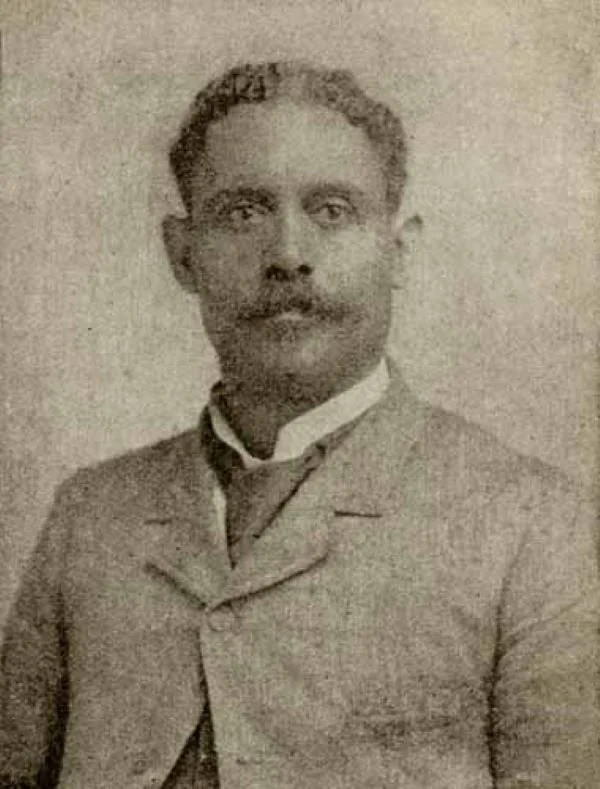
Henry Davis Wood & Annie Riter Wood
Henry Davis Wood was the first official pastor of Faith United Presbyterian Church. The excerpt on Wood and his wife, Annie, found here is made courtesy of Jill Snider from her book, “Head, Hand, and Heart” John Hall Chapel and Its Founders: 1876-1890s.
Rev. Henry Davis Wood arrived in Moore County from Trenton, New Jersey, in the fall of 1879 as a licentiate and recent graduate of Lincoln University’s Theological Department. He initially served under the tutelage of Leonidas Rutherford, a medical doctor and pastor serving small congregations throughout Moore County. Wood’s wife, Anna M. Riter Wood, joined him a little over a year later, and the two began the ministry that would fundamentally reshape the lives of many in Moore County.
The Woods were no ordinary couple, and they brought with them to North Carolina a wealth of experiences that suited them perfectly to the tasks they would inherit. Henry Wood, born free in Trenton on February 10, 1847, was the son of Albert Wood, a hotel waiter, and Lucy Ann Wood. He and his siblings attended Higbee Street public school in Trenton, but Henry’s greatest education came later. As a teenager, he traveled to find work in the Hudson River town of Albany, NY, where he was surrounded by constant, fervent discussion of the Civil War, then nearing the end of its second long year. It would be only a short time before he himself donned a Union uniform. When the Army advertised for volunteers in the spring of 1863 for an all-black regiment, Wood was two years shy of enlistment age, but at sixteen he was sufficiently mature to fool recruiters desperate to fill their quotas. Thus, in April he traveled to Readville, now West Roxbury, outside Boston, and on April 21, 1863, enlisted in Company H of the 54th Massachusetts Infantry Regiment, eager to fight for the end of slavery and to preserve the Union that had allowed him to be born a free man and to obtain an education.
The sights Wood witnessed as a young recruit would have crushed the spirit of many, including men far his elder. Given a single month’s training at Fort Meigs, he sailed from Boston on May 28, 1863, aboard the steamer De Molay, bound for Beaufort, South Carolina. Just six weeks later, having been in the Army for less than three months, he was thrust into the horrific, bloody assault on Fort Wagner, the battle made famous in the 1988 movie Glory. On the morning of July 18, 1863, Wood pushed past his terror to join the charge, and as the fighting unfolded, he watched more than two hundred and fifty of his fellow soldiers, almost half of those around him, collapse dead or wounded or fall into enemy hands. The shock of Fort Wagner and the physical rigors of Wood’s remaining service on Hilton Head Island sorely tested the youngster and left him, like all war veterans, with scars not always visible to others. He would suffer for the remainder of his life with intestinal ailments for which doctors could find no cure.
After the war, Wood returned home to Trenton, where he sought solace and healing in his family, and in his childhood church - First Presbyterian. There he took comfort in the teachings of its stern but kindly pastor, John Hall. There he also met Annie Riter, whose support and nurturance helped him begin to put the war behind him.
Also born free in August 1847, Annie was the daughter of Edward and Lydia Riter, but was by the age of four an orphan. Peter and Hannah Logan raised and educated her in New Castle, Pennsylvania. It is unclear whether the Logans were relatives or adoptive parents, but by age thirteen Annie had left the family and moved to Trenton to be closer to her grandmother, a resident of nearby Bordentown. Annie found work in a confectionery shop in Trenton and, along with several others, boarded at its owner's home.
Eighteen years old when she met Henry Wood, Annie was refined, intelligent, and a devout Presbyterian. She was also someone who, having lost her parents as a young girl, could empathize, if not with Henry’s war experience, at least with the grief with which it had left him. The two quickly formed a deep bond, marrying at First Presbyterian on August 19, 1866, almost a year to the day after his discharge from the Army. Rev. John Hall officiated.
Still envisioning a military rather than a pastoral career, Wood enlisted in the U.S. Navy several months before his marriage. Annie now joined him in New York, where he served aboard the recruit receiving ship Vermont harbored at the Brooklyn Navy Yard. The Navy broadened Wood’s horizons immensely, especially after he was re-assigned in June 1867 to act as cabin attendant for the captain of the frigate U.S.S. Minnesota. For the next seven months, the ship sailed on a training mission to England, France, and Spain. By the time the Minnesota was decommissioned in January 1868 and Wood resumed his old place on the Vermont, he was only twenty-one years old, but he had seen more of life and of the world than most Americans could ever dream of.
When Wood left the Navy in August 1868, he remained in Brooklyn, working there as a shipping clerk. Not many years would pass, however, before Henry became restless. Although his employment was steady, he could not shake the feeling that life demanded more. The church once again helped him focus his energies. Joining Siloam Presbyterian Church in 1872, he and Annie found a welcoming congregation , which only a few months later expressed its esteem for Wood and his youthful sacrifices by electing him to the position of ruling elder.
Siloam’s influence on Henry and Annie Wood was profound. Its minister, Amos Noe Freeman, had taught in the public schools of New Jersey and had started his own school at the Abyssinian Meeting House in Portland, Maine. He and his wife, Christiana Williams Freeman, helped lead the anti-slavery movement in Portland, harboring runaways in their home and assisting them across the Canadian border. Coming to Brooklyn in 1852, they had worked closely with abolitionists in the American and Foreign Anti-Slavery Society and organized to build political support for the Fifteenth Amendment, which granted black men the vote, advocated for women’s rights, and led the fight for school equality in Brooklyn.
By the time Freeman became Henry Wood’s pastor in 1872, he was a figure who commanded great respect, and he was a strong role model for a young man looking for meaning and direction in his life. It was through Freeman’s influence, according to historian G. F. Richings, that Wood felt his call to the ministry. Amos and Christiana Freeman also inspired Annie. Amos Freeman himself had been an orphan, and he showed her how to turn personal pain into constructive work for the church. Christiana, who had always been a partner in Amos’ religious and political activities, also gave Annie a model for sharing in a husband’s ministry. She not only taught at the school at Abyssinian Meeting House, but also served as director of the Colored Orphans Asylum in New York City and led fundraising efforts for Siloam Presbyterian and community organizations.
Through the Freemans, Henry and Annie witnessed a new purpose for the church, one that made sense for their lives. At Trenton’s First Presbyterian, they learned the rudiments of their faith. Now, at Siloam, they had found a model for linking the God of their childhood to the struggle for social justice. They would never look back. In the fall of 1872, they moved to Chester, Pennsylvania, where Henry entered Lincoln University to start his path to the ministry.
Henry would distinguish himself at Lincoln. After two years of preparatory work, he entered the Freshman Class in 1874, and in his junior year in 1877 was selected to speak during the spring Commencement exercises. No record has survived of what Wood said to his fellow students that April day, but his topic, “The Aim of Education,” indicated he was already deeply interested in teaching. The thoughts he shared may have been the kernel of the vision he expressed thirty years later when he wrote, “Education is a powerful factor in shaping human conduct and building human character, but we need to know there is nothing more dangerous to the human mind than education without the capacity to make proper use of it. I would urge then that our education must be a Christian education.”
Completing his senior year at Lincoln in 1878, Wood applied ot the Committee of Missions for Freedmen to work as a missionary. As he waited for an answer, he and Annie moved temporarily to Newport, Rhode Island, where he worked at the Cliff House Hotel, a vacation spot for wealthy tourists. The Woods did not receive a reply as quickly as expected, possibly because just as he submitted his application the church was entering into a serious discussion of the Committee’s continuing existence. Many church members felt that fundraising and programs for the freedmen should be folded into the long-established Home Mission Board rather than remaining separate activities. Others, including the members of the Atlantic Synod, who the previous year had petitioned the General Assembly to keep the Committee whole, thought otherwise. The controversy dragged on throughout the year, erupting into an intense debate the following May at the General Assembly’s annual meeting. Ultimately the arguments of black ministers, who were working in the field in the South and feared a merger would dilute support for their missions, prevailed, and the Committee retained its independent status.
By the fall of 1879, Wood at last had an assignment. A licentiate, he was to be the primary assistant for Leonidas Rutherford at Carthage, Cool Springs, and Blue’s Crossing, and to aid Thomas Hargrave at Nazareth Church in Cameron and Memorial Church in Spout Springs. He found temporary housing in the area, and Annie stayed temporarily with her grandmother in Bordentown. The separation must have been difficult for the Woods, but Annie’s experience during Henry’s stint at sea had taught her self-reliance. Henry had little time to dwell on his loneliness. His new position kept him constantly on the go. As a licentiate, he traveled rutty sandy roads through the pines on horseback to preach to far-flung congregations, teach Bible classes, promote fundraising, oversee church construction, and visit potential converts and the sick and dying. “I travel on hundred and eighty miles a month to reach my churches, and back,” he wrote in November. “From this the committee can see the number of miles I travel in a year, saying nothing of the twenty miles to Memorial, where I go every fifth Sabbath.”
Aware that his own hardships paled in comparison to those of the communities he served, Wood lamented the poverty and meager educational opportunities he saw around him. He called the area he served “the most destitute field in our Presbytery.” Few former slaves owned land; most men toiled in turpentine distilleries, sawmills, or the fields for little money, and women worked as laundresses and field hands. Wood’s churches at Blue’s Crossing and Cool Springs especially reflected the economic circumstances of those building them. The churches were, he wrote, “rude log structures without windows or doors” with rough pine boards for seats. The pulpit at Blue’s Crossing, he stated, was “a box mounted on four sticks.” Wood also noted the scarcity of Bibles and other books for the Sunday Schools.
Henry Wood, however, took inspiration from the men and women around him. He often expressed a deep appreciation for the sacrifice and grit they demonstrated in the face of hardship, and sometimes peril. Wood remarked to the Committee that an “opposing and disturbing element” among the white population had threatened the effort to build a church at Blue’s Crossing. The congregation, however, had persisted, despite the ever-present possibility of violence. No one had forgotten the 1869 shooting of Daniel Blue, and the murder of his pregnant wife and children, burned to death in their home near Blue’s Crossing after Blue testified in a trial against several Klansmen. A spate of other beatings, arsons, and rapes carried out by Klan members near Jonesboro and other towns in 1870 and 1871 were also never far from the minds of Moore’s black residents. Wood, witnessing the courage and faith of those willing to risk their well-being for their faith, found it easier to keep his own.
In the summer of 1880 Wood persuaded a local landowner in Carthage to build a house he could rent, and when it was completed, he and Annie moved permanently to the town. As they rekindled the home life they had so sorely missed, the Woods forged a partnership strengthened by a mutual desire to do God’s work. A talented, energetic woman, Annie proved more than capable of holding up her end of the ministry.
In April 1880, the Presbytery of Yadkin ordained Wood, and the following year the Committee of Missions for Freedmen officially commissioned him as the stated supply minister for Carthage Church, Cool Springs, and Blue’s Crossing, where he had continued the work to erect a church despite the community’s resistance. Between 1880 and 1882, Wood oversaw the raising of new buildings at each of these three locations.
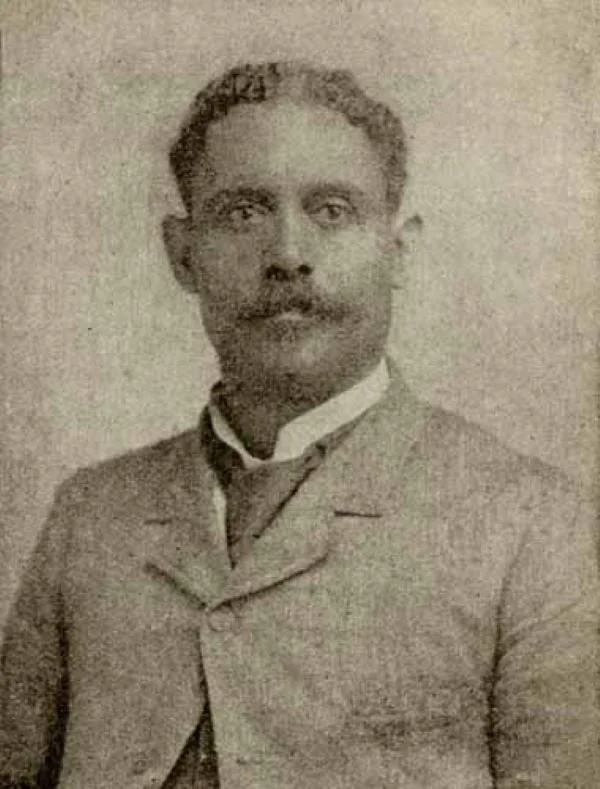
Henry Davis Wood
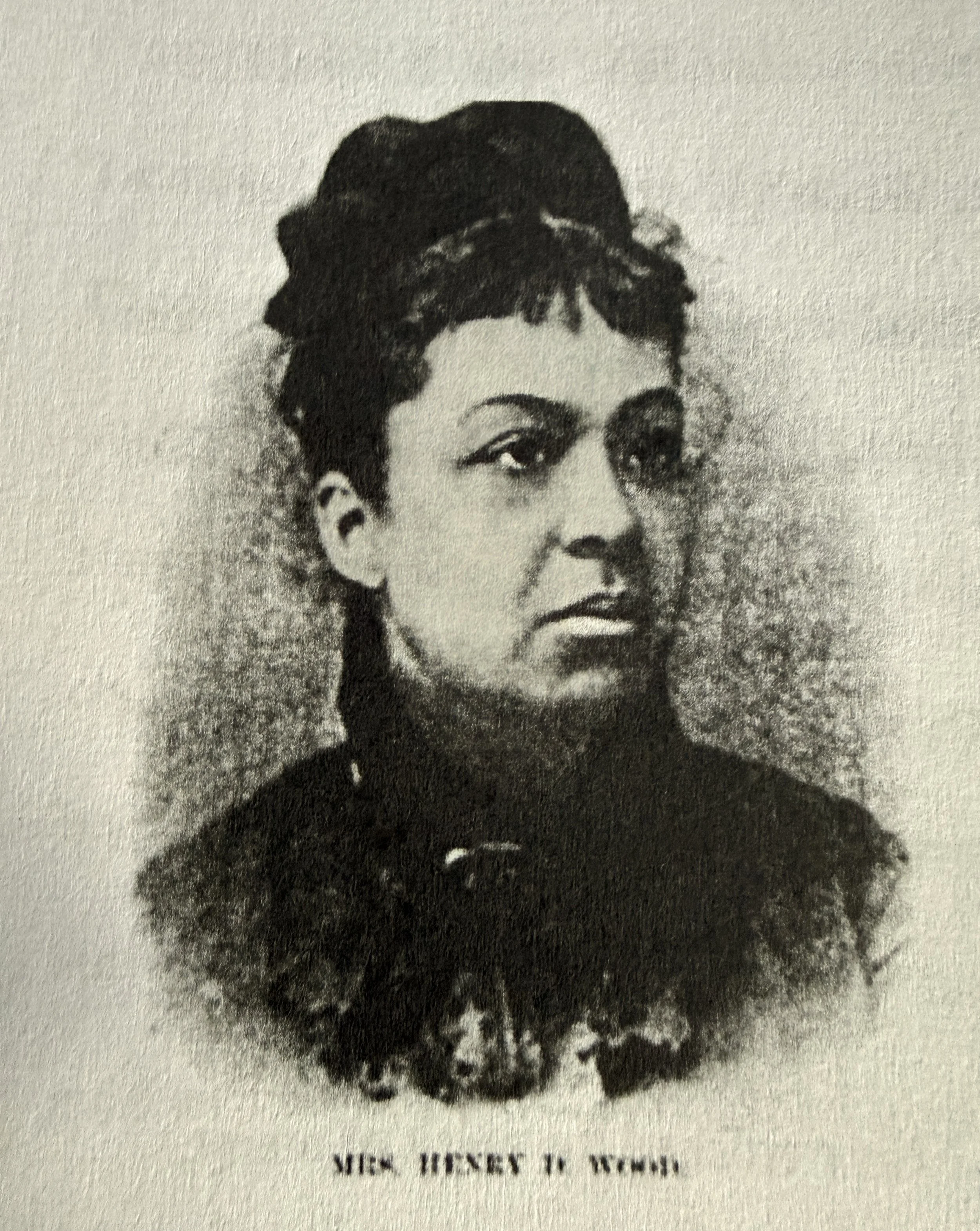
Annie Riter Wood
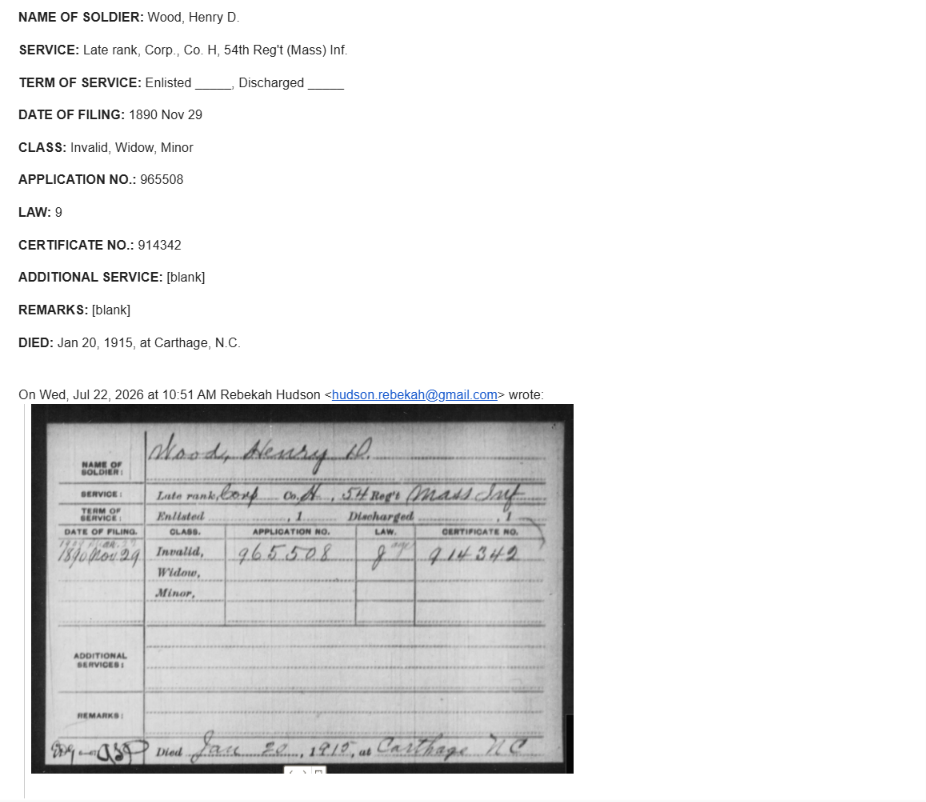
Henry Davis Wood Service Record
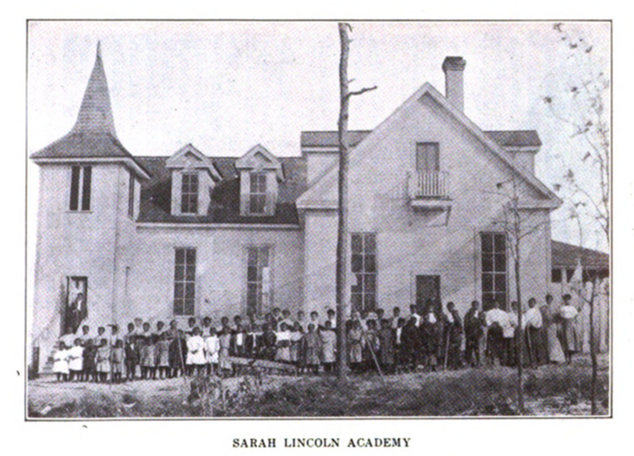
Sarah Lincoln Academy
Sarah Lincoln Academy
Rev. Dr. William Jones Rankin, the second pastor of Faith United Presbyterian Church, was educated at Lincoln University in Pennsylvania and began his pastorate with the newly rebuilt Faith Church and Emmanuel Church (Southern Pines) congregations in 1894. Due to his influence, the original members of Faith were augmented by the influx of well-educated African Americans from the North. As with most Presbyterian churches in the nineteenth century, the congregation soon founded a school, a private academy for their young people, for whom no primary education was available. It was initially known as "The School House in the Woods" or "The School in the Pines" and was run out of the Rankin home. Over the course of several years, the school expanded, additional teachers were hired, and a modest campus was constructed. It was chartered by the Northern Presbytery as Sarah Lincoln Academy in 1896. In 1903, the school became part of the Presbyterian Church USA's Board of Missions. The academy closed in 1932 when public school options became available.